
University of Sussex spinout Universal Quantum has raised $100m (about €89m) in a Series A co-led by DCVC and Firgun Ventures, which it describes as the largest Series A by a UK-headquartered quantum company. The round takes total funding past $125m; the valuation was not disclosed.
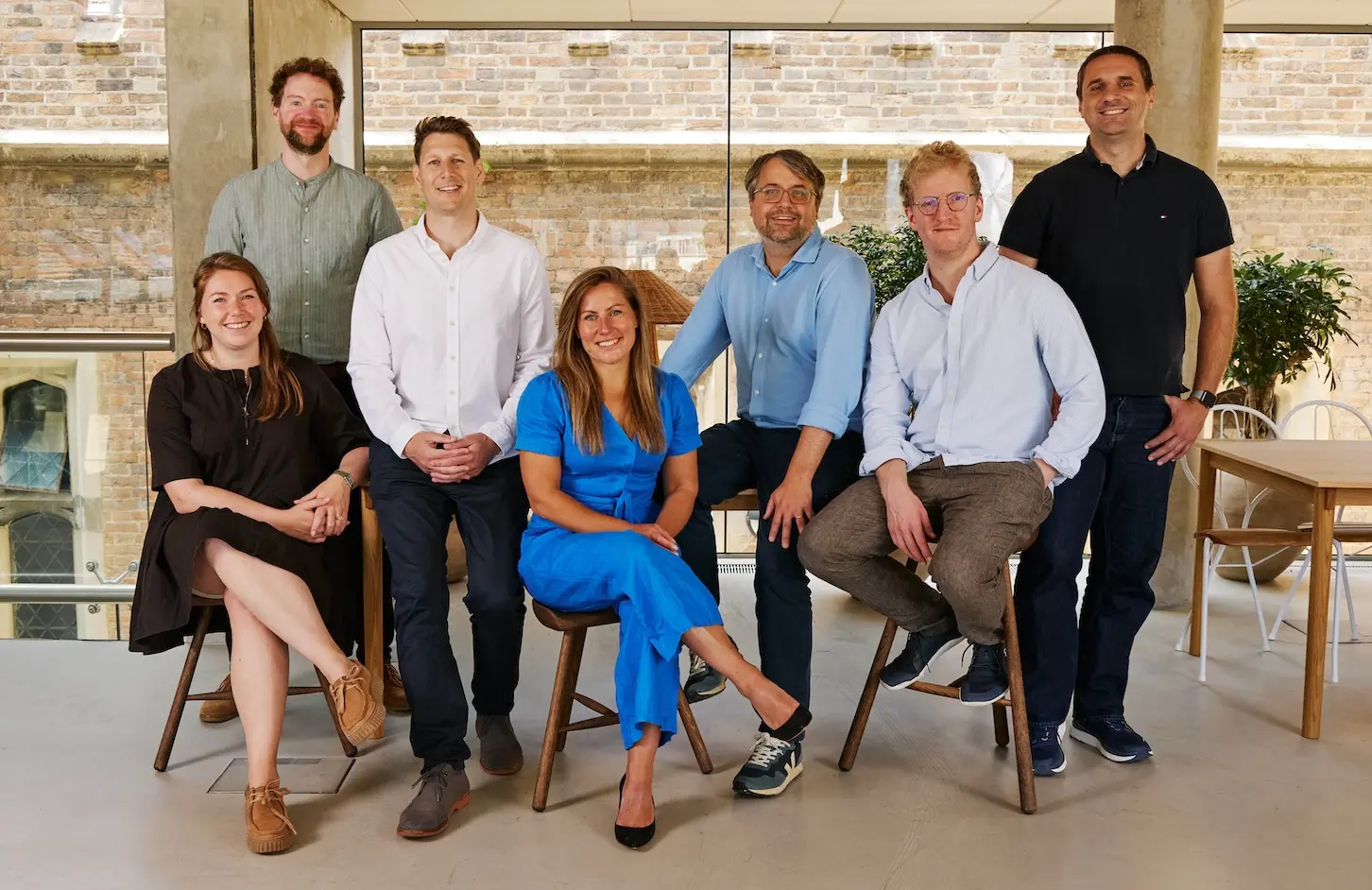
Universal Quantum was founded in 2018 by Professor Sebastian Weidt and Professor Winfried Hensinger of the University of Sussex, the co-authors of a 2017 blueprint for a large-scale trapped-ion quantum computer. The company is based in Sussex, outside the Oxford, Cambridge and Bristol clusters that host most British quantum hardware firms, and now employs more than 100 technical staff across three continents.
The business builds modular trapped-ion machines. Its integrated quantum processing unit is fabricated on a standard 200mm commercial foundry line and controlled with microwaves rather than lasers, while a proprietary interconnect links chips at a reported 2,424 connections per second.
The round
The $100m Series A was co-led by Silicon Valley firm DCVC and quantum specialist Firgun Ventures. Singapore's EDBI, Japanese asset manager Integral GlobalTech, Artal, Main Sequence, Hostplus, NGS Super, IAG Capital, EdenBase and Eigenstate Holdings took part, as did Roblox founder and chief executive Dave Baszucki.
Existing backers Nauta Capital and The Venture Collective also participated. Total funding now exceeds $125m.
Terms were not disclosed. Universal Quantum did not publish a post-money valuation, the split between new and existing investors, or any change to board composition.
The investor base is unusually spread for a British Series A, with sovereign capital from Singapore, two Australian superannuation funds and Japanese and US institutions all on the register alongside European venture funds. Firgun has also backed Oxford Quantum Circuits and Switzerland's ZuriQ this year.
Use of funds
The capital will fund development and commercialisation of the company's chiplet arrays and control systems, which are intended to cut engineering risk on the route to error-corrected machines.
It will also pay for international expansion: a first research and development centre outside Europe, in Singapore, plus growth in the United States, Japan and at the company's German hub in Hamburg.
Revenue before scale
Universal Quantum has contract income that most hardware peers lack at this stage. In 2023 it won a contract worth about €67m from the German Aerospace Centre, DLR, the largest awarded to a UK quantum startup. It is also working with Rolls-Royce on applying fault-tolerant quantum computing to computational fluid dynamics.
The raise lands in a busy year for European quantum hardware. Oxford Quantum Circuits has raised €301m, Delft's QuantWare €152m and France's Quobly €115m, while trapped-ion rivals eleQtron and ZuriQ have secured €57m and €22.4m respectively. Including this round, EU-Startups puts 2026 funding for comparable companies above €803m.
Company-supplied figures put the quantum technology market at $60bn to $100bn a year by 2035. The next test for Universal Quantum is delivery against the DLR contract and evidence that its modular design scales beyond hundreds of qubits per chip.
Original source: Tech.eu — https://tech.eu/2026/10/08/university-of-sussex-quantum-spinout-raises-record-ps100m-series-a/